
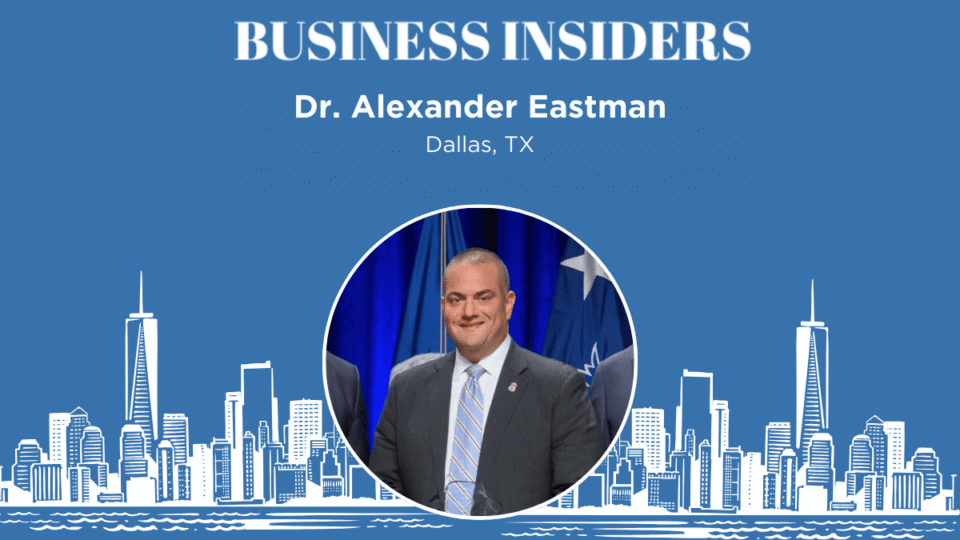
Most people at the top of their field have one career. Dr. Alexander Eastman has built three simultaneously, and the overlap between them has produced some of the most consequential public safety work in the United States over the past two decades.
He is a board-certified trauma surgeon, a surgical critical care specialist, and an emergency medical services physician based in Dallas, Texas. He is also a Lieutenant and the Chief Medical Officer of the Dallas Police Department. And since July 2022, he has served as Senior Medical Officer for Operations at the United States Department of Homeland Security’s Office of Health Security. At any given moment, he may be operating on a critically injured patient, advising federal law enforcement on medical preparedness strategy, or briefing DHS leadership on emergency health policy.
Understanding how one person holds that combination of roles, and does all of them at a serious level, is a useful study in what cross-disciplinary leadership actually looks like when it functions at its highest expression.
The Education That Built the Foundation
Dr. Eastman completed the Plan II Honors Program at the University of Texas at Austin, a highly selective interdisciplinary degree that attracts students oriented toward rigorous, broad-based intellectual engagement. He graduated in May 1996. He then earned his medical degree with distinction from the George Washington University School of Medicine and Health Sciences in Washington, D.C., in May 2001, where he also earned the Alpha Omega Alpha honor and the Paul L. DeWitt Award for Surgical Excellence.
His training continued at UT Southwestern Medical Center and Parkland Memorial Hospital in Dallas, one of the nation’s busiest Level I trauma centers, where he completed residency in general surgery and two specialized fellowships: one in Government Emergency Medical Security Services and Homeland Security from 2004 to 2006, and one in Trauma and Surgical Critical Care from 2008 to 2009. In 2009, he added a Master of Public Health from the UT Health Science Center at Houston and a Certificate in Criminal Justice from Austin Community College, the latter formalizing his transition into active law enforcement alongside his medical practice.
He holds triple board certification from the American Board of Surgery in general surgery and surgical critical care, and from the American Board of Emergency Medicine in Emergency Medical Services, a credential combination that spans the full spectrum from operating room to field emergency response.
Three Careers, One Common Thread
The thread connecting Dr. Eastman’s surgical work, his law enforcement role, and his federal service is not unusual ambition. It is a specific and consistent commitment to closing the gap between where people get hurt and where they get help.
He joined the Dallas Police Department as a Tactical Physician in August 2004, working with the department’s SWAT team to provide medical support in high-risk operational environments. He became a sworn police officer in April 2010, earned the rank of Lieutenant in November 2011, and has served as the department’s Chief Medical Officer since June 2016. In that role, he oversees the medical health and safety of the entire organization, improves emergency response protocols, and ensures that officers receive the care they need in the field and after critical incidents.
His law enforcement service, detailed across his professional profile at dralexandereastman.com, earned him the Dallas Police Department Medal of Valor in July 2017, a Mayoral Proclamation for Valor from the City of Dallas in October 2007, and the 2025 Reserve Officer of the Year recognition from the Dallas Police Association and the Assist the Officer Foundation, announced in January 2026. These are not honorary designations. They reflect active operational service under conditions that most people in either medicine or law enforcement do not encounter.
The intersection of medicine and law rarely produces professionals operating at this level in both fields simultaneously. Dr. Eastman is an exception that the system has benefited from repeatedly.
The Hartford Consensus: A National Impact That Saves Lives
Among Dr. Eastman’s most enduring contributions is his role in the Hartford Consensus, a multidisciplinary initiative convened by the American College of Surgeons to develop evidence-based guidelines for improving survival from active shooter and mass casualty events.
The consensus framework, to which Dr. Eastman contributed across multiple iterations, produced the THREAT protocol, which stands for Threat suppression, Hemorrhage control, Rapid Extrication to safety, Assessment by medical providers, and Transport to definitive care. This framework became the operational foundation for the national Stop the Bleed campaign, launched by the White House and the Department of Homeland Security, which has trained millions of Americans in basic hemorrhage control techniques.
The clinical and policy work behind that campaign appeared in the nation’s most respected medical publications. In 2018, Dr. Eastman co-authored a landmark paper in the New England Journal of Medicine titled “Active-Shooter Response at a Healthcare Facility,” which addressed the specific protocols medical institutions need to protect staff and patients during armed incidents. The paper has since been cited and implemented by hospital systems and emergency management teams across the country.
For anyone working in healthcare leadership, the Hartford Consensus represents one of the clearest examples of clinical research translating directly into national policy and community preparedness outcomes at scale.
Federal Service: DHS and the Architecture of National Medical Preparedness
In July 2022, Dr. Eastman joined the U.S. Department of Homeland Security Office of Health Security as Senior Medical Officer for Operations, a role that places him at the executive level of the federal government’s health and safety infrastructure. He provides protective medicine expertise to DHS principals, serves as the DHS EMS Medical Director, and leads the development and implementation of strategic medical programs across the agency’s operational components.
From June 2023 through December 2024, he also served as Acting Chief Medical Officer for U.S. Customs and Border Protection, leading the Border Health System and providing medical oversight for one of the largest and most operationally complex law enforcement agencies in the federal government. His scope included protecting both CBP personnel and individuals in custody from health hazards, ensuring protocol compliance, and guiding senior leadership on health and medical strategy.
This level of organizational responsibility at the federal level, combined with active clinical practice and departmental law enforcement leadership, represents a span of management complexity that is essentially without parallel in American medicine.
Academic Contributions and Knowledge Transfer
Dr. Eastman’s commitment to advancing the field extends to teaching. He is currently an Associate Professor of Surgery at the Uniformed Services University of the Health Sciences, F. Edward Hebert School of Medicine in Bethesda, Maryland, a position he has held since May 2019. He previously served on the faculty at UT Southwestern Medical Center for nearly a decade.
He co-edited the Parkland Trauma Handbook, Third Edition, published by Elsevier in 2009, a clinical reference that has been used by surgical trainees and trauma practitioners across the country. His peer-reviewed publications span more than 79 journal articles and book chapters, appearing in the New England Journal of Medicine, JAMA, the Journal of Trauma and Acute Care Surgery, and other leading clinical publications. His presentations have taken him to every corner of the United States and to international audiences in Brazil, Turkey, South Africa, Australia, the Netherlands, Denmark, England, and Cuba.
The breadth of that scholarly and speaking record reflects a professional who does not treat clinical expertise as a private asset. He consistently turns what he has learned in the field into resources that improve outcomes for practitioners and patients who will never meet him personally.
A Model of Public Service Leadership
For professionals in public service roles across medicine, law enforcement, and federal government, Dr. Eastman’s career offers a clear demonstration of what sustained commitment to a single mission looks like when pursued across multiple disciplines simultaneously.
The Exceptional Service Medal from the U.S. Public Health Service, awarded in January 2020, and the 2014 Outstanding Young Texas Ex recognition from the University of Texas at Austin are recognitions from institutions on opposite ends of the career arc: one honoring field impact, one honoring early promise. Both are consistent with a career that has delivered exactly what each recognition anticipated.
He is available for consulting and can be reached through his website. Those interested in his academic and research output can explore his full publications record at dralexandereastman.com/publications, and connect with him professionally on LinkedIn.
For more profiles and analysis at the intersection of medicine, leadership, and institutional service, explore the Healthcare, Management, Law, and Service sections at Business Insiders.
