

Ahadu Asres Legesse is a senior project manager in business operations based in Anoka, Minnesota. Over 28 years he moved from operations analyst at Target to project roles at U.S. Bank and Medtronic, and since 2020 he has led cross-functional projects at UnitedHealth Group. His approach to rolling out new business systems comes down to five habits: map how work really gets done, set realistic schedules, communicate on a steady rhythm, raise problems early and support people through the change.
Every growing business eventually replaces a system. A new scheduling platform, a new billing tool, a new way of tracking work. The software is rarely the hardest part. The hard part is keeping customers served and employees productive while everything underneath them changes.
Ahadu Asres Legesse has built his career on that problem. His path is also a useful reminder for business owners and managers that the people who keep large organizations running often start in the least glamorous roles.
Who Is Ahadu Asres Legesse?
Legesse grew up in Anoka, Minnesota, graduated from Anoka High School and earned a Bachelor of Science in Business Administration from Metropolitan State University in Saint Paul in 1997. In 1998 he joined Target Corporation in Minneapolis as an operations analyst and project support specialist, preparing management reports, tracking department activities and keeping project records.
In 2004 he moved to U.S. Bank as a project coordinator and became a project manager there in 2008, leading internal projects, technology updates and changes to administrative procedures. From 2012 to 2020 he managed operational excellence projects at Medtronic in Fridley, reviewing how teams completed their daily work and helping them adopt better procedures. Since 2020 he has been a Senior Project Manager in Business Operations at UnitedHealth Group in Minnetonka.
Four employers, four industries and one consistent job: getting people from different departments to agree on what is being done, by whom and by when, then keeping that agreement current as the work moves.
What Does a Senior Project Manager in Business Operations Do?
At UnitedHealth Group, Legesse develops project plans and timelines, coordinates employees across operations, IT and business support teams, monitors risks, budgets and schedules, and reports progress to department leaders. A large part of the role is supporting the introduction of new business systems and procedures, from planning implementation schedules to helping teams adjust once a change goes live. It is the kind of behind-the-scenes work that keeps healthcare organizations running while their tools evolve.
Why Do New Business Systems Disrupt Daily Operations?
Most rollouts are planned around technical milestones: setup, testing, data migration and go-live. The disruption usually comes later, when employees discover the new system changes how they hand off work, where information lives and who approves what. Steps that were never written down, the informal workarounds every team relies on, break first.
That is true whether the organization has 50,000 employees or 15. A contractor switching job-scheduling software faces the same risk as a hospital system replacing an administrative platform: the work keeps coming while the team relearns how to do it.
How Should Business Leaders Plan a System Rollout?
Legesse’s approach draws on habits he has relied on across his career, and they translate to almost any business.
- Map how the work actually gets done. At Medtronic, much of his work involved reviewing daily workflows to find delays and unnecessary steps. Before a new tool arrives, document current processes, including workarounds, so nothing important disappears at launch.
- Set a realistic schedule. He favors realistic deadlines over optimistic ones. Build in time for training, questions and a support window after go-live.
- Make every assignment clear. He believes people should know what needs to be done, who is responsible and when it is due. Most delays start when one of those is fuzzy.
- Communicate on a steady rhythm. Short, regular updates on progress, risks and decisions needed keep leaders informed without surprises.
- Raise problems early. A small issue reported today is easier to fix than a large delay explained next month.
These are core management disciplines, but they are easy to skip when a launch date is approaching.
How Do You Keep a Rollout on Budget?
Budget overruns on system projects rarely come from the software license. They come from extended timelines, extra training, temporary staffing and productivity lost during the transition. Legesse’s role includes monitoring budgets alongside schedules and risks, and the two are linked: a schedule that slips almost always costs money. Tracking both together, and reporting them in the same weekly update, gives leaders a chance to act while options are still cheap. For owners watching margins closely, that discipline matters as much as any line item in finance.
What Can Smaller and Service Businesses Borrow From This?
Large-company project methods scale down well. A home services company or a growing practice does not need a project office to use them. It needs one person accountable for the rollout, a written list of how work is done today, a launch date with breathing room, and a weekly check-in where problems are raised without blame. Businesses in the service sector, where customer experience depends on smooth scheduling and communication, often feel a bad rollout first and benefit most from a careful one.
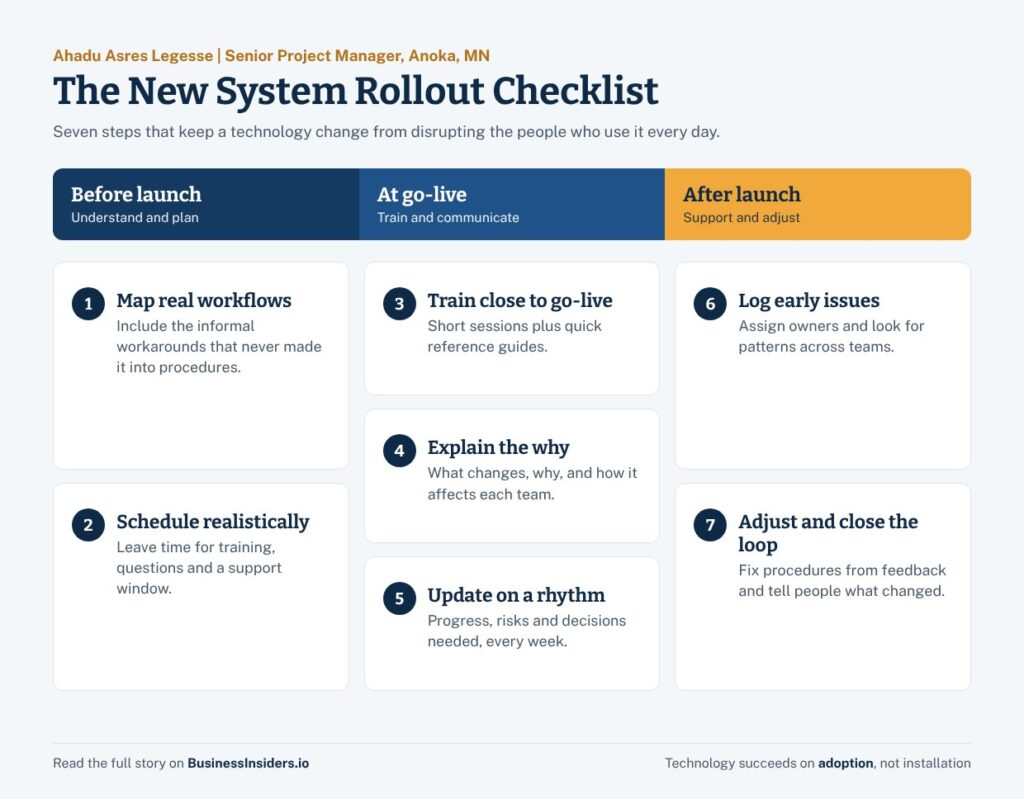
New System Rollout Checklist
- Map current workflows, including informal workarounds.
- Build a schedule with time for training, questions and post-launch support.
- Train close to go-live and provide short reference guides.
- Explain what is changing, why and how it affects each team.
- Send weekly updates covering progress, budget, risks and decisions needed.
- Track early issues, assign owners and look for patterns.
- Adjust procedures based on feedback and tell employees what changed.
Frequently Asked Questions
Who is Ahadu Asres Legesse?
Ahadu Asres Legesse is a senior project manager in business operations based in Anoka, Minnesota, with more than 28 years of experience at Target, U.S. Bank, Medtronic and UnitedHealth Group.
What is the biggest risk in a new system rollout?
The biggest risk is usually adoption, not technology. Employees lose time when undocumented workflows break and training arrives too early or too late.
How long should a post-launch support window last?
It depends on the size of the change, but planning a defined support period after go-live, with clear owners for issues, helps teams recover quickly instead of improvising.
Can small businesses use corporate project management methods?
Yes. A single accountable owner, documented workflows, a realistic launch date and weekly check-ins bring most of the benefit without a formal project office.
Legesse lives in Anoka and is developing The Steady Progress Podcast, a planned series on work, leadership and career growth. More about his career is available on Ahadu Legesse’s website.
