

Most employees never meet the person responsible for the funds in their company retirement plan. At APS Pension & Financial Services in Melville, New York, that person is Steven J. Musmanno, MBA, AIFA, the firm’s Co-Managing Principal and Chief Investment Officer.
APS has designed, administered and invested retirement plans for closely held businesses for more than four decades. Its clients include private companies and nonprofit organizations that offer 401(k), 403(b) and defined benefit pension plans. Musmanno leads the investment side of that work, a role that sits at the meeting point of portfolio strategy, federal retirement law and the day-to-day needs of employers.
What Steven J. Musmanno Does as Chief Investment Officer
At APS, Musmanno sets the asset allocation policy behind the firm’s risk-based portfolios. He leads portfolio management and oversees day-to-day trading. He is also Chief Investment Officer of APS Investment Management, the firm’s institutional fiduciary arm, where he chairs the Fiduciary Investment Committee and serves as its Chief Fiduciary.
The committee reviews investment decisions for the firm’s institutional clients and keeps a written record of each one. For employers, that record matters. Under the Employee Retirement Income Security Act (ERISA), the people responsible for a private-sector retirement plan are fiduciaries who must act prudently and solely in participants’ interest. In 2015, the U.S. Supreme Court confirmed in Tibble v. Edison International that this includes a continuing duty to monitor plan investments.
Musmanno is also a co-founder of APS Wealth Management, LLC, an SEC registered investment adviser, where he serves as Managing Member and Chief Compliance Officer. He works alongside the firm’s actuarial and third-party administration team as a pension and qualified plan consultant, connecting investment decisions with how a plan is designed and run.
From Merrill Lynch Research to Retirement Plans
Musmanno started his career at Merrill Lynch in New York City, in the firm’s investment banking and private client area. He provided equity portfolio strategy to high-net-worth clients and helped syndicate direct placement programs on new equity issues.
He later became Vice President of Institutional Research Marketing, heading marketing and sales for Merrill Lynch’s Emerging Markets Equity Research group. That role placed him between research analysts and the institutional investors who acted on their work, an experience that carries over to explaining investment decisions to employers and plan committees today.
He holds an MBA in finance from NYU Stern School of Business and an undergraduate degree from the State University of New York at Oswego. He also holds the Accredited Investment Fiduciary Analyst (AIFA) designation, which focuses on evaluating whether a retirement plan’s investment process meets a defined standard of care.
How Steven J. Musmanno Frames the Company Retirement Plan
Musmanno views the company retirement plan as more than an employee benefit. For owners of closely held businesses, he sees it as a centerpiece for three goals:
- Tax management. Contributions to a qualified plan can reduce current taxable income, and investment growth inside the plan is tax-deferred.
- Wealth creation. Steady contributions invested over many years, under a written investment policy, give savings time to grow.
- Business equity risk diversification. Many owners hold most of their net worth in the company they built. Retirement savings invested across a range of assets can reduce how much personal wealth depends on one business.
Lessons for Business Owners and Plan Sponsors
The structure Musmanno works within offers practical takeaways for any employer that sponsors a retirement plan, whether or not it works with an outside firm.
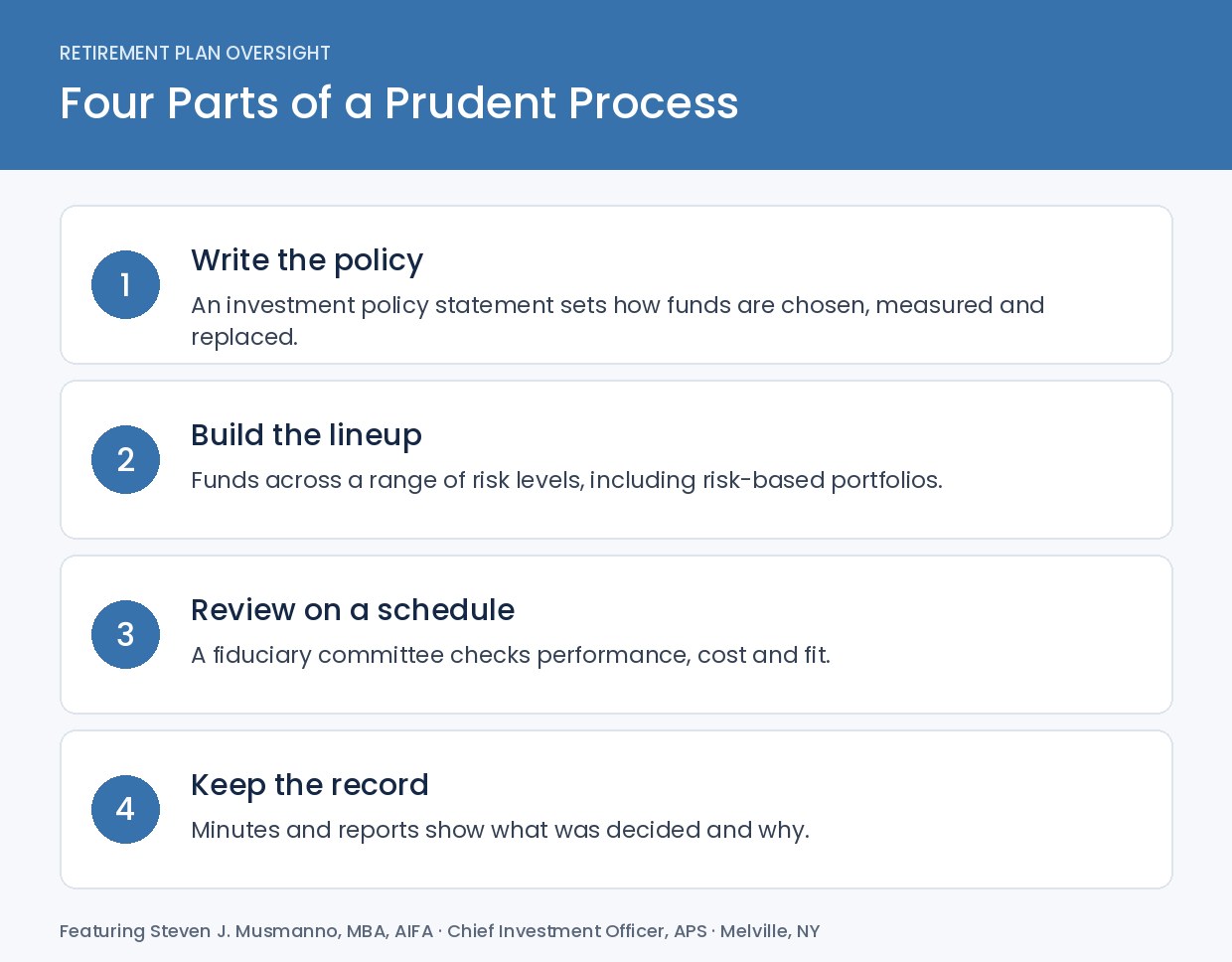
- Put the rules in writing. An investment policy statement is not required by federal law, but it sets clear criteria for choosing, monitoring and replacing funds.
- Review on a schedule. Many plan committees review their fund lineup at least once a year. A fixed schedule keeps monitoring from slipping.
- Know what the plan pays. Service providers to ERISA plans must disclose their fees to the plan sponsor. Someone should read those disclosures and compare costs with similar plans.
- Keep a record. Minutes and reports show that reviews happened and explain why decisions were made. That record is often the clearest evidence of a prudent process.
Readers looking for more on managing a growing company can browse the Management section, and those interested in investing and financial planning will find related coverage under Finance. Profiles of professionals in advisory and client service roles appear in the Service section.
Outside the Office

Health and fitness are a big part of life for Musmanno and his family. He has run several marathons and half marathons, and the family supports the American Heart Association among other causes.
Steven J. Musmanno is based in Melville, New York. His professional background is available on Steven J. Musmanno’s LinkedIn profile.
Steven J. Musmanno is an investment adviser representative of APS Wealth Management, LLC, an SEC registered investment adviser. Registration does not imply a certain level of skill or training. This article is for informational purposes only and is not investment, tax or legal advice.
